Racial Justice
Making D.C. the 51st state is a racial justice issue.
Washington, D.C. has had a significant Black population since its creation and was a majority-Black district from 1957 through 2011. Today, the majority of D.C.’s residents are people of color.
The truth is that the ongoing denial of statehood to D.C. residents is rooted in racism.

In 1867, right after the Civil War, President Andrew Johnson vetoed a bill that would grant citizens of the District — including Black men — the right to vote.
Congress overrode the veto, briefly granting notable and historic political influence to Black Washingtonians.
But just as Black voters started to exercise their political power in D.C., Congress quickly replaced D.C.’s local government with federally appointed commissioners, blocking the heavily-Black region from having full voting rights or control over its local government.
Congress’s goal was clear: to disempower an increasingly politically active Black community.
In 1890, Senator John Tyler Morgan of Alabama stated, after “the negroes came into this district,” it became necessary to “deny the right of suffrage entirely to every human being.” Senator Morgan explained his rationale shamefully saying Congress had to “burn down the barn to get rid of the rats.”
Black organizers have long led efforts to enfranchise D.C. residents.
In 1957, D.C. became the first majority-Black major city, and the broader civil rights movement supported D.C. democracy.
For example, immediately after attending the signing of the Voting Rights Act in 1965, Martin Luther King, Jr., attended a march for D.C. home rule.
Local civil rights leader and D.C. Delegate to Congress Walter Fauntroy directly helped register voters in congressional districts where Black voters could swing elections.
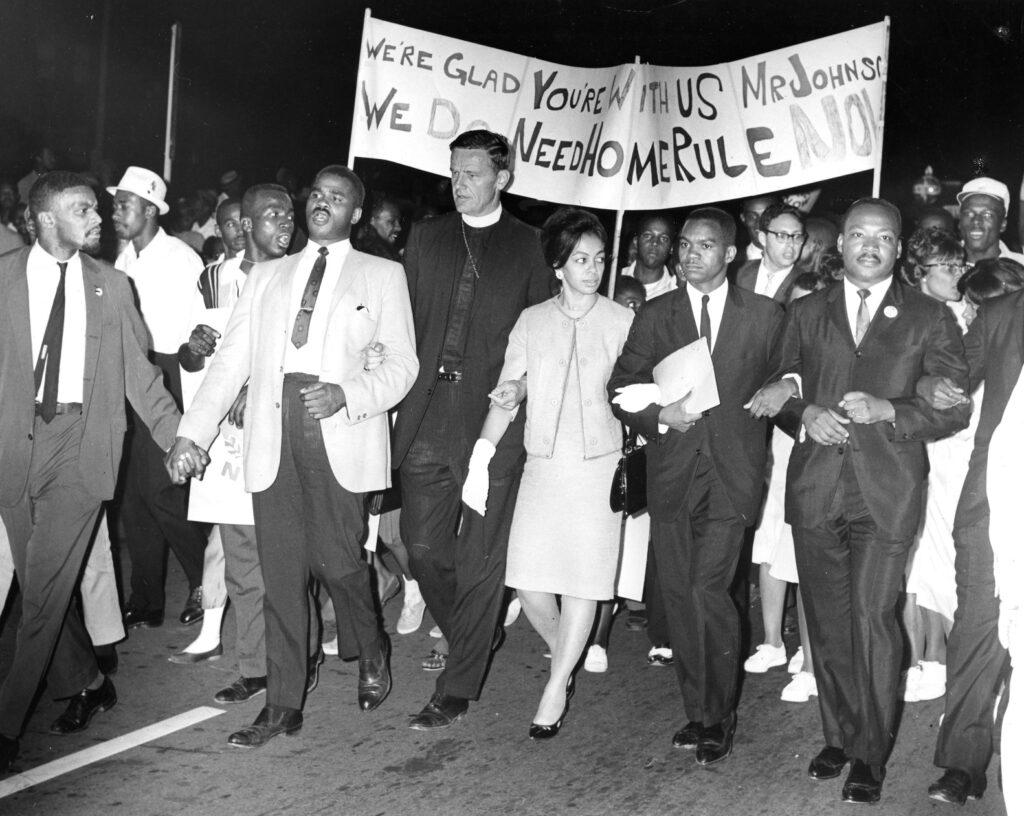
Thanks to leaders like Fauntroy, D.C. democracy became a central issue for Black voters around the country. This organizing strategy eventually ousted segregationist Representative John McMillan of South Carolina, who had long blocked D.C. democracy on the House District Committee.
With McMillan gone, Representative Charles Diggs, a civil rights advocate and Michigan’s first Black member of Congress, became chairman of this committee in 1973.
A huge, if incomplete, victory came with the passage of the D.C. Home Rule Act of 1973.
This law passed as a compromise between D.C. residents who wanted full democratic rights and members of Congress who wanted to maintain power over D.C. and its majority-Black population.
The law allowed D.C. residents to elect a local government that would oversee the day-to-day functioning of the District, while Congress maintained power over local laws, the local budget, and other matters.
The continued subjugation of D.C. to undue federal power harms all D.C. residents, the majority of whom are Black and brown.
For example, Congress regularly blocks D.C. from using local tax dollars to fund abortion care through the Dornan Amendment, which prevents Medicaid dollars from being spent on abortions.
Because abortion is not federally protected anymore, an anti-D.C. Congress could try to restrict or even ban abortion in D.C.
This Medicaid abortion ban significantly harms many residents of color. In 2024, 80 percent of D.C. Medicaid recipients were Black and about 12 percent were Hispanic.