National Guard
On August 11, 2025, President Trump announced that he was deploying National Guard troops to patrol Washington, D.C. Despite a lawsuit, protests by D.C. residents, and opposition from local elected leaders, the Pentagon confirmed that National Guard troops will continue to patrol the District until the end of Trump’s term in January 2029.
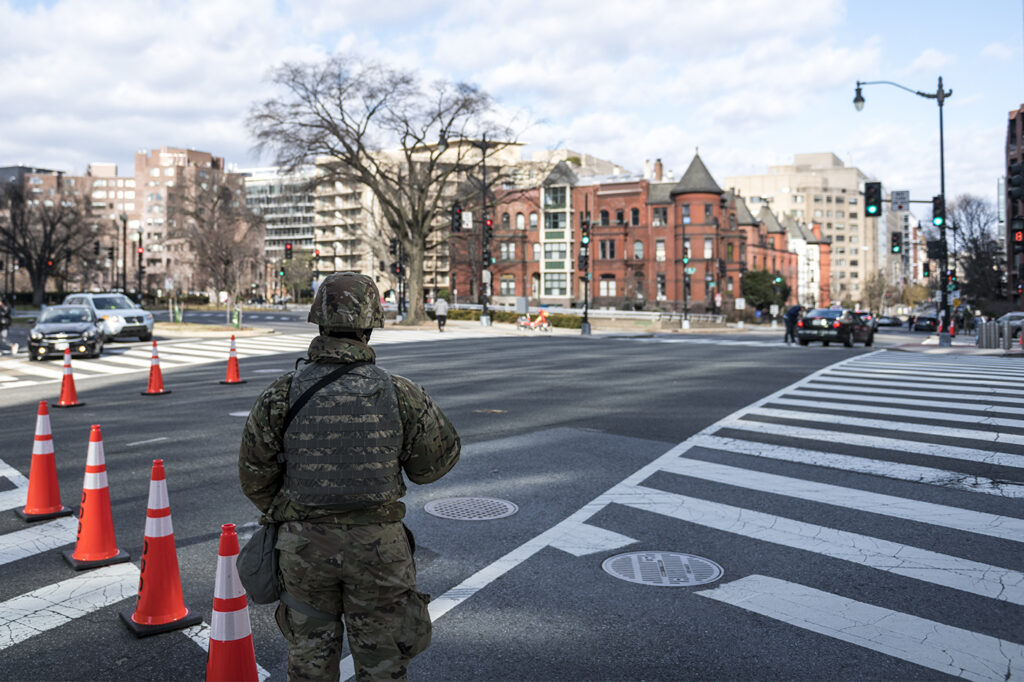
Why can President Trump deploy the National Guard to D.C.?
Because without statehood, D.C. does not control our own National Guard — the president does.
As commander of the D.C. National Guard, the president can also ask governors from other states to send their National Guard troops here, even when the people of D.C. and our elected officials do not want armed troops patrolling the streets where we live and work and where our kids go to school and play.
As retired US Army Major General Randy Manner, who served as the Acting Vice Chief of the National Guard Bureau, explains in this video, the National Guard is not trained to patrol civilians. General Manner was “appalled” by this deployment, saying there is “no legitimate mission” in D.C.
Guard members should be home with their families unless they are needed for a real emergency, particularly when their unjust deployment in D.C. costs taxpayers $3 million per day.
The deployment risks normalizing what is not normal. Armed troops should not patrol our streets. We have seen the damaging results. National Guard members have violated people’s most fundamental constitutional rights.
In 2025, Sam O’Hara was handcuffed for playing the “Imperial March” from Star Wars while walking behind National Guard troops. Mr. O’Hara began his creative form of protest. Sgt. Beck of the Ohio National Guard did not take kindly to O’Hara’s actions. Sgt. Beck summoned D.C. police officers to “handle” Mr. O’Hara, who was handcuffed and detained, in violation of the First Amendment.
In 2026, Anna King, a combat veteran and Purple Heart recipient, was sitting on her front patio when three National Guard members walked through her gate told her that she was detained, and violently restrained her. The Guard members pinned her to the ground, kneeled on her back, and handcuffed her tightly, refusing to loosen the handcuffs after she complained. King suffered significant injuries from the incident, particularly in her wrist, which required surgery. King, a retired Army captain, continues to experience significant physical and mental effects of this assault.
Unfortunately for the whole country, what happens in D.C. does not stay in D.C.
President Trump is using D.C. to see how he and his allies can grab power in other states and cities.
After D.C., Trump set Chicago as his next target. But because Illinois is a state, elected officials sued over Trump’s attempt to deploy the National Guard, and the Supreme Court let stand a lower court’s decision to block this unlawful deployment.
Trump’s unprecedented siege of the nation’s capital and its spread to other places shows just how dangerous it is to let the president and other politicians use D.C. as their testing ground for extreme politics.
We need to stop this abuse of power at the source.
National Guard troops must go home, and D.C. must become the 51st state. Our local and national democracy depend on it.
National Guard Deployment FAQ
How many National Guard members are deployed in D.C.?
4,440 National Guard members have been deployed to D.C. as of August 18, 2026.
What authority does the president have over the D.C. National Guard?
Without statehood, D.C. does not control our own National Guard – the president does.
What role or authority do governors from other states have?
Governors control their state’s National Guard, and they can send their members to other places that request them. As commander of the D.C. National Guard, the president has the authority to ask governors from other states to send their National Guard troops to D.C. against the will of D.C. residents.
How much does the D.C. National Guard deployment cost?
At the current troop levels, the Washington, D.C. deployment is costing taxpayers around $3 million per day.
If the National Guard deployment to Washington, D.C. continues into 2029, as the Pentagon plans, it will cost taxpayers $1.4 billion. That amount would fund 10,473 nurses for a year.
What can people who don’t live in D.C. do to help?
Send a message to Congress urging them to stop micromanaging our nation’s capital and oppose any future interference in D.C.’s home rule.