Taxes and Local Rights
The people who live in D.C. are just like people who live in any other state. We are working families, nurses, small business owners, bartenders, and construction workers.
But because D.C. is not recognized as a state, the president and Congress have extraordinary powers to dictate what happens in Washington, D.C.
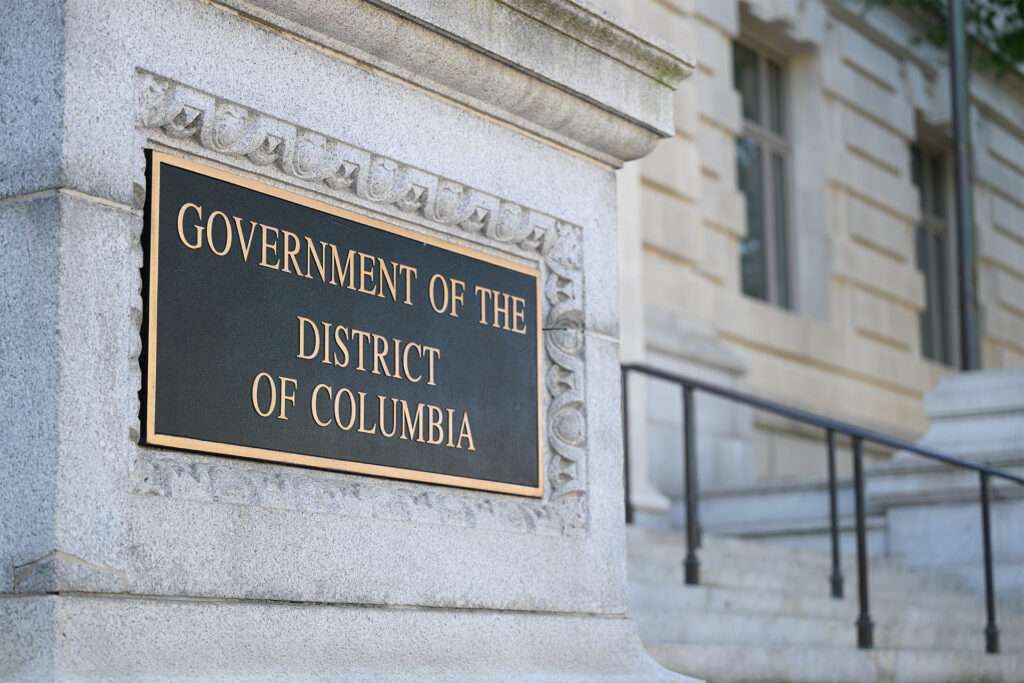
Taxation without Representation in Our Nation’s Capital
The people who live in Washington, D.C. pay federal taxes, just like everyone else. But unlike people in every other state, we are denied full voting representation in Congress.
- D.C. residents pay more taxes per person than residents in any other state in the country and more total federal income taxes than 12 states, yet we have no say over how Congress spends our federal tax dollars.
- “No taxation without representation” was the rallying cry of Americans against Britain in the Revolutionary War, which led to the foundation of our country.
Today, only residents of D.C. and Puerto Rico are still taxed without representation.
Unfair Federal Intrusion on Local Freedoms and Democracy
Without D.C. Statehood, Congress – where D.C. residents have no vote – has the power to dictate local laws and how tax dollars are spent in Washington, D.C.
Congress has so much power over Washington, D.C. because of a flawed historical compromise that allows federal overreach right in our nation’s capital.
Like any other state, D.C.’s local government has the power to pass and enforce local laws and to pass the District’s budget.
However, unlike a state, Congress has the power to overturn local laws, dictate how D.C. can use its own local tax dollars, and create its own laws for D.C. without any input from residents or local elected officials.
Here’s a recent and troubling example. In February 2026, Congress abruptly barred D.C. from using nearly $700 million of our own local tax dollars.
Congress voted to remove nearly $700 million of local tax dollars from the D.C. budget while the budget was already in progress.
People who live and work in D.C. were thrown into limbo simply because Congress, where D.C. residents have no vote, decided to overturn local tax law.
This kind of federal overreach is simply unthinkable in any other state.
Imagine if Congress had the power to overturn or dictate local laws and budgets for Michigan, New Hampshire, Washington, North Carolina, or any other state.
But to make this analogy more accurate, remember that D.C. has no voting representative in Congress.
So, imagine telling members of Congress from a state to leave the room while politicians from the rest of the country determined local laws and budgets for that state.
When you put it in perspective, D.C.’s lack of statehood makes no democratic sense at all.
We can’t let Congress trample local freedoms and rights anywhere in this country, including our nation’s capital.
Inefficient Waste of Congressional Time and Energy
Congress was elected to address national challenges, not to micromanage local decisions in Washington, D.C.
- Yet, over 60 bills have been introduced in the 119th Congress to interfere in D.C.’s local affairs, including routine issues that should be handled locally.
- For every one bill that Congress has introduced to tackle inflation, they have introduced over three bills to micromanage local D.C. affairs.
- For example, HR 5525 introduced by Rep. Perry of Pennsylvania would make it impossible for elected D.C. officials to prohibit right turns on red.